

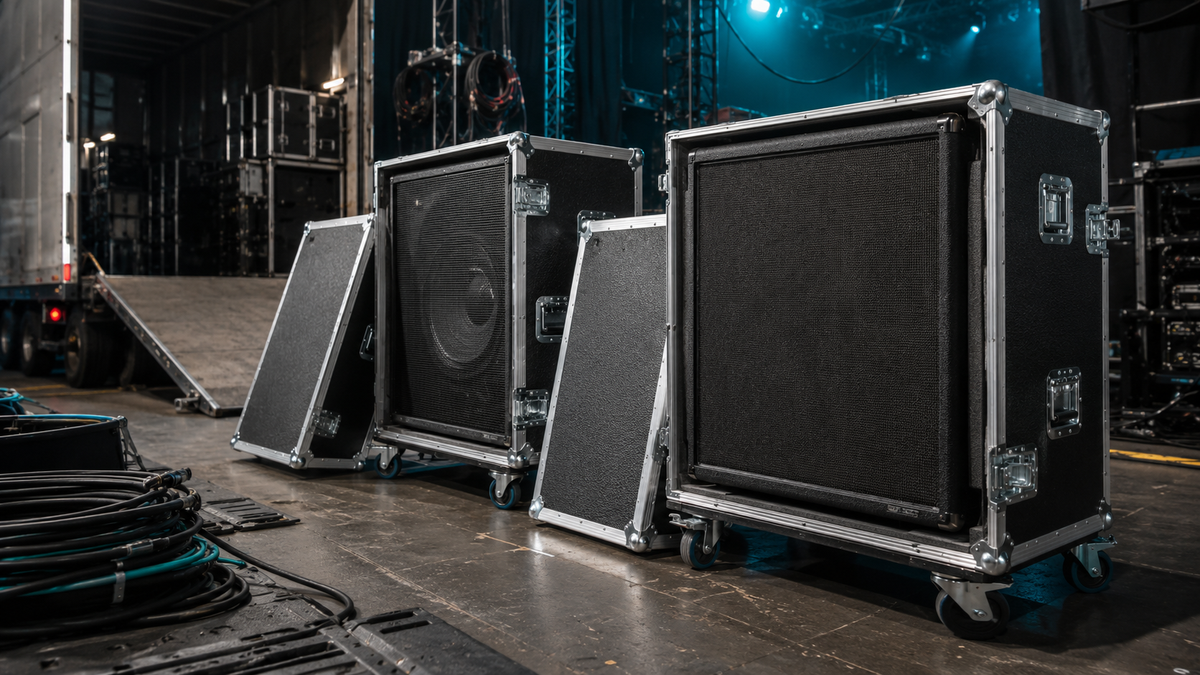
Quick answer
Live-in speaker cases are ATA road cases built so the cabinet stays permanently inside. A removable front or lid exposes the speaker for use, so the crew never lifts the cabinet in or out. That single change cuts handling at every load-in and load-out, which is where most stage setup time disappears.
Ask any monitor engineer where the night really gets eaten, and the answer is rarely the show. It is the load-in, the line check, and the scramble back into the truck before the venue cuts the lights. Live-in speaker cases are built to attack exactly that window. The cabinet lives in the case full time; you pull a lid, and it is ready to make noise. Here is why that design saves real minutes on every stop, and how to spec one that actually holds up.
In this guide
New to stage cases?
If you are still sorting out how speaker and wedge transport works, start with the full range and see what fits your rig.
Browse speaker and stage monitor cases →What a live-in speaker case actually is
A live-in case is an ATA road case sized so the speaker cabinet never comes out of it. Instead of dropping the cabinet into a snug interior for transport and lifting it back out at the venue, you remove a lid or a front panel, and the speaker is already deployed, sitting on its casters, ready to fire. The case becomes part of the cabinet for the life of the tour.
That is the whole trick, and it changes the math of a stage. Standard transit cases assume the gear comes out before use. Live-in speaker cases assume it never does. You will see them most on guitar and bass backline (think a Marshall 412 that stays in its shell all run), on Leslie cabinets that nobody wants to wrestle twice a day, on powered subs and tops in a corporate AV kit, and on monitor wedges that get kicked around a stage for months. Anywhere a cabinet gets used as often as it gets moved, a live-in build earns its keep.
Where your setup time actually goes
Setup time is not one big block. It is a hundred small handling steps stacked end to end, and cabinets are some of the worst offenders because they are heavy, awkward, and there are usually several of them. Walk through a normal load-in for a single cabinet in a standard case and count the moves:
- Roll the case to position.
- Pop the latches and pull the lid.
- Lift the cabinet out, often a two-person job once you pass 50 lbs.
- Set it where it goes.
- Move the empty case offstage so it is not a trip hazard, then find somewhere to stash it.
Now run that in reverse at the end of the night, in the dark, while you are tired and the venue is hovering. Multiply by the number of cabinets in the rig. On a wedge-heavy monitor world or a backline with three or four amp stacks, the lifting alone can swallow fifteen to thirty minutes a side, and every lift is a chance to drop a corner, tweak a back, or crack a baffle. The empty cases pile up backstage too, eating floor space you do not have.
How live-in cases cut the clock

Live-in speaker cases delete the two slowest steps: the lift out and the lift back in. You roll the case to its spot, pull the lid, and the cabinet is live. At the strike, you drop the lid back on, latch it, and roll it to the truck. The cabinet has not left the shell once. For a crew, that is the difference between handling a speaker twice per cabinet per show and handling it zero times.
The time savings compound in three ways. First, the obvious one: no lifting, so no lifting time. Second, fewer hands are needed, so the same two techs can deploy more cabinets in the same window or get freed up for patch and line check. Third, and people forget this, you stop losing time to damage. A cabinet that never gets manhandled in and out does not develop the cracked corners and loose handles that turn into a mid-tour repair. Keeping the gear in one piece keeps you on schedule, which is its own kind of setup time saved. If you are building or refreshing a touring kit, it is worth reading our complete guide to ATA road cases for touring productions to see how live-in builds fit the rest of the rig.
The construction that makes it work

A live-in case has a tougher job than a standard transit case, because it is the cabinet's permanent home and its everyday workhorse. It gets opened and closed every single show, rolled across stages, and stacked in the truck. That is why the build matters more, not less.
ATA-300 panels and the right plywood
The shell should be built to ATA-300 Category 1 spec: laminated plywood with riveted aluminum extrusion on the edges, not stapled particleboard. For speaker cabinets that take real road abuse, 3/8" plywood is the workhorse gauge. It shrugs off the forklift bump and the tailgate drop that would split a thinner panel. Our heavy-duty 3/8 ply ATA speaker cabinet case is built around exactly this, sized to your cabinet rather than a generic box.
Removable lid or front, and how it latches
The lid is the part you touch every day, so the latch hardware has to be honest. Recessed butterfly latches sit flush so nothing snags during the load, and they take the repeated cycling without working loose. Spring-loaded recessed handles do the same on the carry points. A live-in design usually pulls a full front or a top lid to expose the driver's face, with enough clearance that the grille and any pole-mount or rigging points clear the case edge.
Casters, corners, and ventilation
Because the cabinet lives on its casters, size them for the load. 4" casters handle most single cabinets; heavier doubles and subs want larger wheels with a higher rating so they roll over cable ramps and door thresholds without fighting you. Steel ball corners take the stacking and the truck-pack abuse. For powered cabinets, the build should leave ventilation and rear-panel access so amp modules can breathe and you can reach the inputs without opening the whole case.
Live-in vs. standard transit case
Both protect the cabinet in the truck. The difference is what happens at the venue. Here is the honest tradeoff:
| Factor | Live-in speaker case | Standard transit case |
|---|---|---|
| Setup at venue | Pull lid, cabinet is live | Open, lift out, set, stash case |
| Handling per show | Zero cabinet lifts | Two lifts minimum (in and out) |
| Backstage footprint | Lid stows flat, no empty case to stash | Empty case takes floor space all show |
| Footprint on stage | Slightly larger (case stays on) | Bare cabinet footprint |
| Best for | Daily use, fast turnarounds, fly dates | Occasional moves, tight stage space |
The one place a standard case wins is raw stage footprint, since a live-in cabinet carries its shell into the show. For most touring and rental work that is a fair trade, because the minutes you save and the damage you avoid outweigh a couple extra inches around the base.
Compare your options
Once you know live-in is the move, look at the cabinet styles Gravix builds this way, from amp stacks to powered tops and subs.
See live-in speaker cabinet ATA casesMatching the case to your cabinet
A live-in case lives or dies on fit. Too loose, and the cabinet shifts and rattles in the truck. Too tight and you cannot get the lid off cleanly, which defeats the whole point. The case has to be built around the exact cabinet, including handles, casters, grille, and any pole cup or rigging hardware that sticks out.
That is why most live-in cases are made to spec. A Marshall 412 cabinet case is dimensioned for the angled or straight 412 it carries; a Leslie shell, a powered 18" sub, and a coax top each need their own interior. Get the exterior measurements of the cabinet, add the depth of any protruding hardware, and build from there. When you measure, work from the widest and tallest points, not the nominal cabinet size, because the grille frame and corner protectors are what the lid actually has to clear.
If you run a mixed AV kit with screens, amps, and speakers all moving together, it helps to standardize the whole package. Browsing the broader audio and video ATA cases alongside your live-in speaker builds keeps the fleet consistent, so any tech can open any case and know what they are looking at.
When a live-in case is worth it (and when it is not)
Live-in speaker cases are not the right call for everything, and a good case builder will tell you so. They shine when a cabinet gets used as often as it moves: nightly tours, busy rental inventory, corporate AV kits that ship and deploy on tight clocks, and fly dates where every handling step is a paid minute. The faster your turnarounds, the more a live-in build pays back.
They make less sense when a cabinet ships rarely and then sits, or when stage real estate is so tight that the extra footprint of the shell genuinely matters. In those cases, a snug standard transit case, or even a padded gig-style cover for light duty, can be the smarter spend. The honest answer depends on your run, and matching the duty level to the actual use is what keeps you from overbuying or underprotecting. Because the case stays with the cabinet for its whole life, build quality is also what you are leaning on for the long haul, which is worth checking against the Gravix warranty policy before you commit.
Get a live-in case built for your exact cabinet
Send your cabinet model or measurements, and Gravix will spec a live-in build sized to fit, latch clean, and survive the road.
Request a custom quote →FAQ
What does "live-in" mean for a speaker case?
It means the speaker cabinet stays inside the case permanently. You remove a lid or front panel to use the speaker rather than lifting the cabinet out, then close it back up to roll it to the truck. The cabinet effectively lives in the case for the life of the tour, which is where the term comes from.
How much setup time do live-in speaker cases actually save?
It depends on the rig, but the savings come from deleting every cabinet lift in and out. On a backline or monitor world with several cabinets, that can be fifteen to thirty minutes per side at both load-in and strike, plus the time you would have spent stashing empty cases and dealing with handling damage.
Do live-in cases protect the cabinet as well as standard transit cases?
Yes, when built to ATA-300 spec. A live-in case uses the same laminated plywood, aluminum extrusion, recessed latches, and ball corners as a transit case. Because it is opened every show, the latch and lid hardware should be rated for daily cycling, and the shell often runs 3/8" ply for cabinets that take heavy road use.
Can a live-in case be made for any speaker cabinet?
Most can. Live-in cases are typically built to spec around a specific cabinet, from a Marshall 412 to a Leslie, a powered sub, or a coax top. You provide the exterior dimensions plus any protruding hardware like grilles, handles, and pole cups, and the case is dimensioned to fit and latch cleanly around it.
Are live-in speaker cases heavier or bigger than the cabinet alone?
Slightly, since the shell stays on during the show. The added footprint is usually a few inches around the base, and the casters carry the weight, so it does not change the lift. For daily-use touring and rental gear, most crews accept the small size increase in exchange for the handling time it removes.
When should I choose a standard transit case instead?
Choose a standard case when the cabinet ships rarely or when stage space is so tight that the extra footprint matters. A snug transit case protects just as well for occasional moves. Live-in cases earn their keep when a cabinet gets used as often as it gets transported, which is most touring and rental work.