

Quick answer
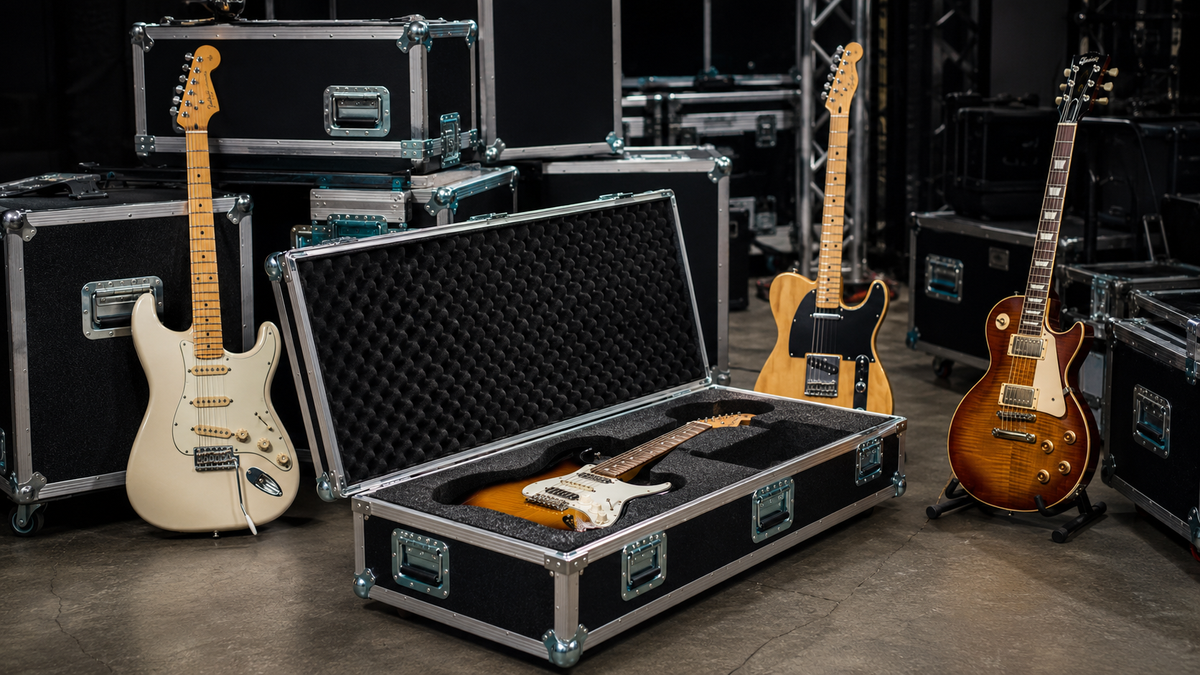
An ATA guitar case is a plywood flight case built to the ATA-300 spec that protects a Strat, Tele, or Les Paul through the truck, the load-in, and the cargo hold. Choose 1/4-inch ply for regional gigging and 3/8-inch ply for hard touring, with a shaped foam interior that cradles the headstock and body.
Your guitar survives the stage just fine. It is everything around the gig that breaks instruments: the tailgate drop, the cargo bin, the gear pile in the back of the van. A gig bag handles the walk from the car to the green room. When the guitar has to ride with the rest of the rig or check as airline cargo, you want a real flight case. This guide breaks down how to pick an ATA case for the three shapes most players own, what actually protects the instrument, and when a stock case is enough versus when you should have one built.
In this guide
New to flight cases?
Start by seeing what a true road case looks like next to the gig bag you already own. The full range of builds for electrics, acoustics, and basses lives in one place.
Browse ATA guitar and bass cases →What an ATA guitar case actually is
ATA stands for the Air Transport Association, the body whose ATA-300 standard defines what a case has to withstand to ride as checked or freight cargo: repeated handling, stacking, and the rough treatment of a baggage system. An ATA guitar case is built to clear that bar. The shell is laminated plywood, not blow-molded plastic, bonded to an aluminum extrusion frame at every edge, with a foam-lined interior shaped to the instrument so it cannot shift.
That construction is the difference between a case that looks tough and one that is. A molded plastic case flexes and cracks at the corners when a heavier case lands on it. A plywood ATA case spreads that load across the frame and the foam, so the energy never reaches the neck or the headstock. For a working player whose Strat or Les Paul is also the instrument they record and rely on, that margin is the whole point.
Why body shape matters: Strat, Tele, and Les Paul

A case only protects a guitar if the interior matches the outline. The three shapes most players carry sit in different parts of the case, and a generic rectangular box leaves the worst gaps exactly where the instrument is most fragile.
A Stratocaster has a contoured double-cutaway body and a long bolt-on neck, so the headstock sits far from the body and needs its own support. A Telecaster shares that bolt-on neck length with a flatter slab body, which packs easily but still wants headstock relief. A Les Paul is the outlier: a heavier single-cutaway mahogany body with a set neck and a sharper back-angled headstock that is the single most break-prone point on the instrument. Drop a Les Paul on its case end, and the headstock takes the hit. A foam interior cut to cradle that angle, with the neck supported and the headstock relieved from contact, is what keeps a set-neck guitar in one piece.
This is why Gravix builds shape-specific interiors rather than one box for everything. A light-duty ATA case shaped for Strat, Tele, and Les Paul bodies holds each outline snugly so the guitar does not slide, while leaving the neck and headstock cushioned rather than pinned.
Duty levels: 1/4-inch vs 3/8-inch plywood
The biggest spec choice is plywood thickness, and it is a real tradeoff between weight and protection. There is no single right answer; it depends on how the guitar travels.
| Spec | 1/4-inch (light duty) | 3/8-inch (heavy duty) |
|---|---|---|
| Plywood thickness | 1/4 in (roughly 6 mm) | 3/8 in (roughly 9 mm) |
| Best for | Local and regional gigs, van and trailer travel, occasional flying | Full tours, frequent flying, gear that ships as freight |
| Weight | Lighter, easier on solo load-ins | Heavier, but takes far more abuse |
| Stacking | Handles light stacking | Built for heavy cases stacked on top |
| Cost | Lower | Higher |
If you mostly drive to gigs within a few hours of home and the guitar rides upright in the van, the 1/4-inch build is the sweet spot. It clears the ATA bar, weighs less, and saves your back on a solo load-out. If the guitar flies regularly, gets handed to a baggage crew, or ships ahead to the next city, step up to 3/8-inch ply. The extra weight buys you a shell that shrugs off the stacking and drops that wreck thinner cases.
Anatomy of a case that holds up

Plywood thickness sets the floor, but the hardware and the interior decide whether the case survives a real tour. Here is what to look for.
Foam interior. The foam is what actually touches the guitar, so it matters more than the logo on the lid. A shaped or CNC-cut cavity holds the body outline; layered foam in the lid presses down to keep the instrument from rattling. The neck should rest in a channel, and the headstock should sit in relief, never bearing weight. Avoid a case where the guitar floats loose or, worse, gets jammed in so tight that the wood is under constant pressure.
Latches. Recessed butterfly twist latches sit flush with the shell so nothing snags on a doorframe or another case, and they lock positively so the lid never pops in transit. Surface latches that stick out are the first thing to shear off.
Ball corners. Steel ball corners take the impact at the most exposed point of the case and let cases stack and interlock. They are non-negotiable on anything that flies.
Handles. Spring-loaded, recessed handles fold flat and sit balanced so a guitar case carries level instead of nose-diving. On a heavier touring build, that balance is the difference between a clean carry and a banged-up corner.
Compare your options
Ready to match a case to your guitar? The Fender-style ATA build covers Strat, Tele, and Les Paul outlines and lets you pick the 1/4-inch or 3/8-inch shell based on how hard you travel.
See the Strat, Tele, and Les Paul caseGig bag, hardshell, or ATA case?
Not every guitar needs a flight case, and owning the right mix is smarter than overbuying. Think of it as three tiers for three jobs.
A padded gig bag is for short hops: the car to the venue, a rehearsal across town, a quick session. It protects against bumps and weather, not against being stacked under amps. If the guitar never leaves your hands, a gig bag from a soft and gig-style case lineup may be all you need.
A standard hardshell is the molded case most guitars ship with. It is fine for storage and careful transport, but the plastic flexes and the latches are light, so it is not built for the cargo bin or a packed trailer. An ATA case is the upgrade for anything that travels with other gear, gets handled by people who are not you, or flies. The rule of thumb: if you are not the one carrying it the whole way, put it in an ATA case.
Carrying several guitars and the rest of your rig
Most working players do not tour with one guitar. Once you are running a Strat for the clean tunes and a Les Paul for the heavy set, a case per guitar eats van space fast. A guitar vault that holds up to six electrics with built-in drawers consolidates the whole collection into one rolling case, with storage underneath for cables, strings, and tools. For a band sharing transport, that single vault replaces a stack of individual cases.
The same thinking applies to the rest of the rig. Your pedalboard and amp travel just as rough as the guitar and deserve the same protection. Gravix builds matching ATA cases for pedalboards and effects and for amp combos and instrument gear, so the whole setup loads in and out as a consistent, stackable system instead of a mismatched pile. For a wider look at casing an entire backline, the working musician's guide to ATA road cases for instruments walks through the full kit.
How to buy the right case
Once you know the duty level and the shape, buying the right case comes down to a few checks.
Measure your guitar. Note overall length, body width at the widest point, and total depth including the strap buttons and any non-standard hardware. A Floyd Rose tremolo, a thick carved top, or oversized tuners can all change the depth the case needs.
Confirm the headstock fit. This is where set-neck guitars get damaged. Make sure the interior supports the neck and relieves the headstock rather than letting it press against the foam or the shell.
Decide if a stock case fits. A standard Strat, Tele, or Les Paul drops into a shape-matched stock case without fuss. But if you play an Explorer, a Flying V, a baritone, a headless, an extended-scale build, or anything with a non-standard outline, a generic case leaves dangerous gaps. That is when a built-to-spec case earns its cost: Gravix cuts the foam to your exact instrument and sizes the shell around it, so an odd-shaped guitar gets the same snug, supported fit a Strat gets off the shelf.
Need a case built around your exact guitar?
Odd body shape, several guitars to carry, or a foam interior cut to your precise instrument? Gravix builds it to spec, so the fit is exact instead of close enough.
Request a custom quote →Frequently Asked Questions
Is an ATA guitar case worth it for a Strat, Tele, or Les Paul?
Yes, if the guitar travels with other gear, gets handled by anyone but you, or flies. An ATA case clears the ATA-300 standard for cargo handling, while the molded case a guitar ships with is built only for careful, hands-on transport. For a Les Paul especially, the headstock protection that an ATA case gives is worth the cost.
Should I get 1/4-inch or 3/8-inch plywood?
Pick 1/4-inch for local and regional gigging where the case rides in your own van and weight matters on solo load-ins. Pick 3/8-inch if the guitar flies often, ships as freight, or gets stacked under heavier cases. The thicker shell weighs more but takes far more abuse before anything reaches the instrument.
Can one ATA case fit a Strat, a Tele, and a Les Paul?
A shape-matched single case is cut for one outline at a time, but Gravix offers a multi-guitar vault that holds up to six electrics, including all three shapes, in one rolling case with storage drawers. For players carrying more than one guitar, the vault saves space and protects every instrument in a single load-in.
Will an ATA case fit a guitar with a Floyd Rose or carved top?
It can, but you have to account for the added depth. A Floyd Rose tremolo, a thick carved maple top, or oversized hardware changes how deep the interior needs to be. Measure the guitar at its thickest point, and if a stock case runs tight, a built-to-spec case sized to your instrument removes the guesswork.
What protects the guitar's neck and headstock inside the case?
A well-built case supports the neck in a foam channel and relieves the headstock so it never bears weight or presses against the shell. This matters most on set-neck guitars like the Les Paul, where the back-angled headstock is the most break-prone point. Shaped or CNC-cut foam keeps the instrument cradled instead of loose or pinned.
Do I need an ATA case if I have a hardshell already?
A standard molded hardshell is fine for storage and careful transport, but the plastic flexes and the latches are light, so it is not rated for cargo handling or heavy stacking. If the guitar leaves your hands during transit or rides with the rest of the backline, an ATA case is the upgrade that actually protects it.