

Quick answer
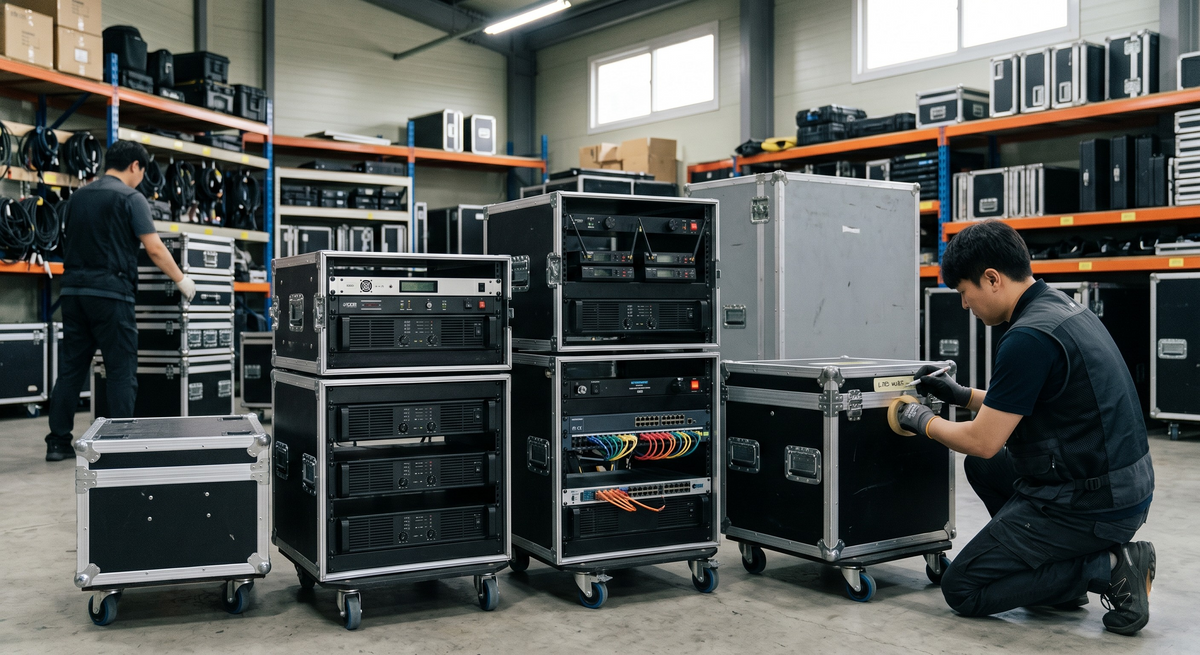
For most AV rental fleets, the ATA rack cases that earn their keep are 4U to 8U builds in 16 to 18 inch depths, heavy-duty 3/8 inch plywood, on casters. Those sizes fit the gear clients rent most: power amps, conditioners, wireless, and switches. Larger 16U-plus cases sit idle far more often.
A rental fleet only makes money on cases that go out the door. Buy the wrong rack sizes and you tie up cash in inventory that gathers dust between gigs. Buy the right ones and the same SKU pays for itself a dozen times over. This guide breaks down which ATA rack cases rental houses actually move, what depth and duty level to spec, and where to stop spending.
In this guide
Building out a fleet?
Start by browsing the full range of sizes and depths so you know what is standard before you commit to a stocking list.
See the full ATA rack case range →How ATA rack cases are sized
Two numbers define a rack case: rack spaces and depth. A rack space, written as U, is 1.75 inches of vertical mounting height on a standard 19 inch rail. A 4U case gives you 7 inches of usable rack height; an 8U case gives you 14 inches. Depth is measured as the rackable space behind the rails, which is what actually limits the gear you can mount. The exterior is always larger than the rackable interior because the lids, foam, and rail offset eat space front and back.
For a rental operation, the spec that matters is the pairing. A 6U case in a 12 inch depth and a 6U case in a 24 inch depth rent to completely different clients and cost very different money to build. Get specific about both before you buy, because a deep case that only ever holds shallow gear is wasted freight weight and wasted shelf space.
The rack sizes that actually get rented
Utilization is everything in a rental fleet. The point is not to own every size; it is to own the few sizes that go out week after week. Across live sound, corporate AV, and broadcast rentals, demand clusters hard in the small-to-mid range. The very small and the very large cases exist for a reason, but they spend more time on the shelf.
| Rack size | Typical rented gear | Best depth | Fleet demand |
|---|---|---|---|
| 2U | Wireless mic receivers, DI/interface, single processor | 12 to 16 in | High, cheap to stock |
| 4U | Power conditioner, network/Dante switch, small power amp | 16 to 18 in | Very high, the workhorse |
| 6U | Amp stack, wireless rack, stage box and split | 16 to 18 in | Very high |
| 8U | Power amps, UPS, processing, playback | 18 to 24 in | Strong |
| 12U | Larger amp racks, server, comms | 18 to 24 in | Moderate |
| 16U+ | Full processing/playback systems, big productions | 24 in | Lower, project-driven |
If you are stocking from scratch, weight your first order toward 4U and 6U cases. They cover the broadest slice of rented gear, they nest neatly on a truck, and a client who needs more height usually books two of them rather than one oversized case. A solid all-rounder is a 4U 16 inch deep heavy-duty rack case, which handles a conditioner, a switch, and a processor with room to spare.
The 16U-plus end is where rental dollars get stuck. Those cases are heavy, awkward to handle, and often spec'd for one specific production, so they sit between bookings. Own a couple if your client base demands them, but do not let big cases dominate a fleet that lives on turnover.
Depth is the other half of the spec

Rack height gets all the attention, but depth decides what actually fits and whether the rack rails do their job. Shallow cases in the 12 to 16 inch range suit wireless receivers, DI boxes, and signal processing, which mount on the front rail and weigh almost nothing. Deep cases in the 18 to 24 inch range are for heavy gear: power amps, UPS units, and anything with chassis rails that need rear support.
That rear support is the part rental houses overlook. A single power amp cantilevered off the front rails will sag, crack a faceplate, or sheer its ears off on the first hard load-in. Anything past about 12 inches of mounting depth should sit in a four-post case with front and rear rails. For a fleet, the practical move is to stock shallow cases for light gear and reserve your deep four-post cases for the amp and power racks that genuinely need them. Mixing those up is how you end up renting a 24 inch case to hold a single 2U interface.
Duty level: why a rental fleet buys heavy
Plywood gauge is the difference between a case that survives ten years of rentals and one that delaminates inside two seasons. Lightweight 1/4 inch plywood builds are fine when one careful owner handles the case. A rental case does not get that treatment. It gets dragged across loading docks, stacked under heavier cases, and returned by clients who do not own it and will not baby it.
For that reason, rental fleets should standardize on heavy-duty 3/8 inch plywood built to the ATA-300 transit spec, with recessed butterfly latches, spring-loaded handles, and steel ball corners. Those parts are the ones that fail first under abuse, so spending up front on the hardware is cheaper than re-casing later. The longer service life also protects your margin: a heavy case that bills out a hundred times before retirement beats a light one that needs replacing after thirty. Gravix builds rack cases to that standard and backs them, which you can read about in the Gravix warranty policy.
Stocking more than a few
Outfitting a fleet is a volume buy, not a one-off purchase. Per-unit pricing drops sharply once you order multiples of the same size, so it pays to plan the whole stocking list at once.
See bulk pricing for fleetsShock-mount racks and when they pay off
A shock-mount rack suspends an inner rack frame on foam or spring isolators so the gear floats inside the outer shell. Road vibration and drop shock hit the case, not the equipment. They cost more and weigh more than a standard rack, so they are not the right call for every SKU in your fleet.
Where they earn their premium is sensitive, expensive, client-owned gear: media servers, computers, hard-drive-based playback, and delicate DSP. If a client is renting a case to fly or truck a server across the country, a shock-mount rack case both protects the gear and lowers your liability if something arrives dead. A useful rule for a fleet: keep your bread-and-butter amp and utility racks in standard builds, and hold a small number of shock racks in 8U to 12U for the high-value bookings that justify the upcharge.
Rack-mixer combos and drawer cases
Not every rental client wants a bare rack. Small live-sound and corporate jobs often book a combo: a slant-top mixer well over a vertical rack, so the whole front-of-house lives in one rolling case. These move well for weddings, conferences, and house-of-worship rentals where a single operator runs everything. Stocking a few rack and mixer combo cases lets you rent a complete small system instead of two separate pieces, which usually books at a better rate.
The other quiet earner is storage. Crews need somewhere to throw cables, adapters, tools, and spares, and a rack case is the wrong place for loose gear. A handful of ATA drawer cases rounds out a fleet so a client can rent a tidy, organized package rather than a pile of racks plus a cardboard box. Small additions like these raise the value of a booking without adding much to your inventory cost.
Standardizing the fleet
A fleet built on a handful of repeated sizes is easier to run than one full of one-offs. When your 4U and 6U cases share the same footprint, they stack square on a truck, label cleanly, and let you swap foam and gear between them. That standardization speeds up prep, cuts loading errors, and makes asset tracking far simpler when forty similar cases are circulating at once. For a deeper look at structuring inventory this way, see how AV rental houses build a standardized case fleet.
Two practical specs support that. First, put casters on anything 6U and up. Clients will drag a wheeled case and lift a handled one, and the dragged case is the one that survives. Standardize on 3 to 4 inch casters with a brake so handling is predictable across the fleet. Second, decide on a foam strategy: convoluted or layered foam for general protection, or CNC-cut foam for cases that always carry the same gear. For a rental house, modular layered foam usually wins because the same case can be re-tasked between bookings instead of being locked to one device.
When your demand does not match a stock size, that is the moment to build to spec rather than force-fitting gear into the wrong case. An odd rail height, a non-standard depth, a custom interior, or branded panels are all straightforward on a made-to-order rack, and ordering several at once keeps the per-unit cost in line with stock pricing.
Build your rack fleet to spec
Tell us the sizes, depths, duty levels, and quantities you need, and we will quote a fleet built to last through years of rentals.
Request a fleet quote →Frequently Asked Questions
What size ATA rack case is most popular for rentals?
The 4U and 6U sizes are the workhorses of most rental fleets. They fit the gear clients rent most often, like power conditioners, network switches, wireless racks, and small amp stacks, and they handle and stack easily on a truck. A client needing more height usually books two of them rather than one oversized case, which keeps your most-rented SKUs in constant rotation.
What rack depth should a rental fleet stock?
Stock both. Keep shallow 12 to 16 inch cases for light front-rail gear such as wireless and processing, and deeper 18 to 24 inch four-post cases for heavy gear like power amps and UPS units that need rear rail support. Most fleets find a 16 to 18 inch depth covers the widest range of bookings, with a smaller number of 24 inch deep cases for amp and power racks.
Are 1/4 inch or 3/8 inch plywood rack cases better for rentals?
For rentals, 3/8 inch heavy-duty plywood is the better buy. Rental cases get handled by people who do not own them, so they take far more abuse than a privately owned case. A heavier ATA-300 build with steel ball corners and recessed latches lasts through many more bookings, which lowers your replacement cost per rental over the life of the case.
When is a shock-mount rack case worth the extra cost?
Use shock-mount racks for sensitive, high-value gear such as media servers, computers, and delicate DSP, especially on bookings that fly or truck long distances. The isolated inner frame absorbs vibration and drop shock so the equipment arrives intact, which protects both the gear and your liability. For standard amp and utility racks, a regular heavy-duty build is enough.
Should rental rack cases have casters?
Anything 6U and up should be on casters. Clients drag a wheeled case and risk dropping a handled one, so the wheeled case survives longer and arrives back in better shape. Standardize on 3 to 4 inch braked casters across the fleet so handling is consistent and prep stays fast when many cases are moving at once.
Can I order rack cases in bulk with custom sizing?
Yes. Because Gravix builds to spec, you can order matched fleet quantities in standard sizes or request custom rail heights, depths, foam interiors, and branded panels. Ordering multiples of the same size brings the per-unit price in line with stock pricing. Send your stocking list through a custom quote and we will build the fleet around your gear.