

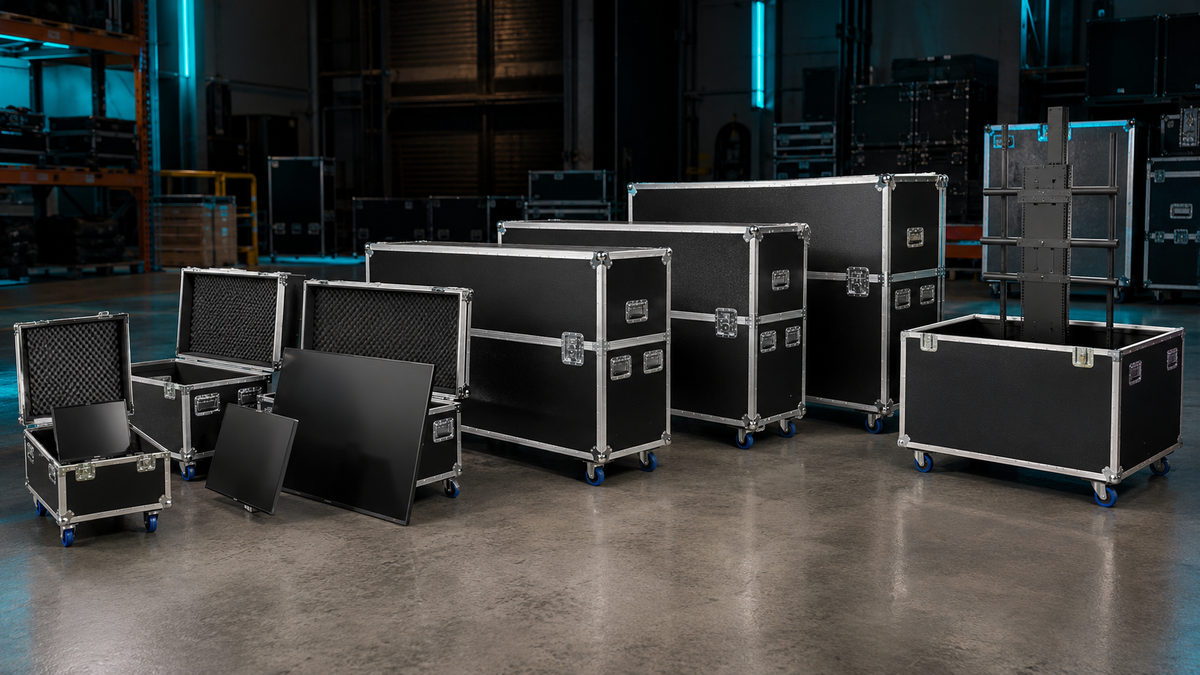
Quick answer
Flat screen cases are sized to the display's diagonal, then matched to its real width, height, and depth (including bezel and any attached stand). Gravix groups them into bands from under 42 inches up to 80 inches and larger, with light, medium, and heavy-duty builds. For odd sizes or AV integration, cases are built to spec.
A cracked bezel or a sheared corner on a 70-inch panel is not a repair; it is a replacement, and usually a missed show. The right flat screen case is the cheapest insurance you will ever buy for a display, but only if it actually fits the screen you are moving. This guide walks through how case sizing works across the full range, from a 32-inch monitor to an 80-inch-plus video wall panel, so you order once and order right.
In this guide
New to ATA flat screen cases?
Browse the full lineup first to see how cases are organized by screen size, then come back and match your display to the right band.
See all flat screen cases →How flat screen case sizing actually works

The number everyone quotes is the diagonal, measured corner to corner across the active screen. That number gets you into the right band, but it is not enough to confirm a fit on its own. Two 65-inch TVs from different makers can vary by an inch or more in overall width once you count the bezel, and that inch is the difference between a panel that seats cleanly in foam and one that gets forced in and stressed at the corners.
Before you order, measure three things on the display itself: total width including the bezel, total height including the bezel, and depth at the thickest point. On modern LED panels, the thickest point is usually the lower third where the boards and connectors live, not the glass. If the screen ships with feet or a stand you plan to leave attached, measure with them on, because that changes both depth and how the panel sits inside the case.
One more habit worth keeping: write down the make and model. When you are spacing foam or asking for a build to fit a specific panel, the model number settles arguments that a rounded diagonal cannot. It is also what lets a case maker cut an interior that holds the screen at the bezel and keeps pressure off the glass.
The size bands from 32" to 80"+
Gravix sorts flat screen cases into diagonal bands so you can shop by the number you already know. Bands overlap slightly on purpose because real panels do not stop at round numbers, and a 50-inch screen may live comfortably in either the medium or large group depending on its exact footprint. Use the table to find your starting point, then confirm with the three measurements above.
| Size band | Typical use | What to watch |
|---|---|---|
| Under 42" | Monitors, confidence displays, small signage | Light enough that handles and a snug interior matter more than wheels |
| 42" to 50" | Meeting rooms, booths, secondary displays | The most varied bezel widths, so measure before you assume |
| 51" to 60" | Main stage and presentation screens | Weight starts to demand casters and good corner protection |
| 61" to 70" | Large venue displays, broadcast monitors | Two-person lift territory; lid clearance over the panel matters |
| 71" to 80" | Showroom and event hero screens | Glass flex over distance; foam must support the full face |
| 80"+ | Giant displays and video wall panels | Almost always a heavy-duty or custom build with handling features |
If your display sits at the low end, the lineup of cases for screens under 42 inches keeps things light and easy to carry. Step up to the 42 to 50-inch flat screen cases for meeting rooms and booth displays. Once you cross into the bigger panels, the 61 to 70 inch range, and the dedicated 80 inch and larger cases add the handling features the weight starts to demand.
Compare your options
Most stage and presentation displays land in the 51 to 60-inch band. See the builds sized for that range, from single-screen to two-screen cases, before you commit to a type.
Browse 51" to 60" casesSingle screen vs. multi-screen cases
A single-screen case holds one panel in a fitted interior and is the simplest, lightest option when you always move the same display. A 2-in-1 or multi-screen case carries two panels back to back, separated by a center pad, and earns its keep when you ship a matched pair or want one case that flexes across a couple of sizes.
The tradeoff is straightforward. Two screens in one case means more weight on the casters and more value riding on a single drop, so the build needs to be stout and the interior has to keep the two faces from ever touching. Many adjustable models cover a span, for example, a case rated for 32 to 55-inch panels, which is useful for an integrator who fields a mix of room sizes. Just remember that an adjustable case is sized to its largest screen, so a small panel inside a big case still needs foam to take up the slack.
Duty levels: light, medium, and heavy
Duty level is set mostly by the plywood gauge and the hardware, and it should track how rough the display's life actually is. A screen that rides in a padded van to a quarterly meeting does not need the same case as one that flies cargo and gets thrown on a truck five nights a week.
| Duty level | Typical build | Best for |
|---|---|---|
| Light | Thinner shell, basic latches, foam-lined | Occasional moves, controlled transport, lower weight priority |
| Medium | 1/4 inch ply, recessed hardware, casters on larger sizes | Regular regional travel and repeat load-ins |
| Heavy (ATA-300) | 3/8 inch ply, ball corners, butterfly latches, edge casting | Flights, daily touring, freight, and high-value panels |
ATA-300 is the spec that road cases reference for air transport durability. In practice, it means a rigid plywood shell with metal edge casting, recessed latches and handles that will not snag or pop in transit, and ball corners that take the hit when a case is dropped on its edge. For anything expensive going on a plane or a daily truck, heavy-duty is the honest answer. Gravix backs its builds with a published warranty, which is worth a read before you decide how much case your display warrants.
Foam, lids, and hardware that matter
The shell stops the impact; the foam decides whether that impact reaches the glass. For flat panels, you want the face supported and the bezel cradled so the screen is held at its strong edges, not pressed against the display surface. Layered or convoluted foam handles most touring duty, while a CNC-cut interior shaped to a specific model gives the cleanest fit and the least movement, which matters most on the big, flexible panels.
Lid design is the other detail people overlook. A telescoping or adjustable lid lets one case clear panels of slightly different depths, which is handy when a stand stays attached. Recessed butterfly latches and spring-loaded handles keep the case profile clean so nothing catches during a load-in. In the largest cases, position and number of casters decide whether one person can steer it or whether it takes two, so look at the wheel layout, not just the wheel count.
Power lift and AV integration builds
For AV integrators and broadcast crews, the case is often part of the deployment, not just the transport. A motorized lift case carries the display flat, then raises it to viewing height on site, so a single tech can set a heavy screen without a stand, a second pair of hands, or a wrestling match. That turns a fragile, two-person task into a button press, which is exactly what you want when you are setting twelve rooms before doors.
If your deployment leans this way, the electric power lift cases are built around that workflow, with the screen mounted to a powered column inside an ATA shell. For a fuller look at how integrators standardize transport across a kit, the AV integrator's guide to custom ATA transport cases covers fleet logic, foam strategy, and the case features that save labor on repeat installs.
When to go custom
A stock band case is the right call when your panel sits comfortably inside a standard size, and you do not need anything unusual from the interior. Go custom when the math stops working: a non-standard diagonal, a panel that has to ship with its stand or mount attached, a screen thicker than usual because of an integrated player or sending card, branded panels for a touring look, or a fleet of cases that all need to match.
Because Gravix builds cases to order, a custom flat screen case is not an exotic request; it is the normal path for odd sizes and AV integration work. You give the screen dimensions and the model, specify duty level, foam type, lift, or no lift, and any handling features, and the case is built to that spec. For a display you cannot afford to replace, a case cut to the exact panel is cheaper than a single broken screen.
Have an odd size or an AV deployment to spec?
Send your screen dimensions, model, and duty level, and Gravix builds the flat screen case to fit, from 32 inches to 80-plus.
Request a custom quote →Frequently Asked Questions
How do I measure a TV for a flat screen case?
Start with the diagonal to find the right band, then measure the panel's total width and height, including the bezel, plus the depth at its thickest point. If a stand or feet stay attached, measure with them on. Note the make and model too, since two screens with the same diagonal can differ by an inch in width.
What size flat screen case do I need for a 65-inch TV?
A 65-inch display falls in the 61 to 70-inch band. Confirm the fit with the panel's exact width, height, and depth rather than the diagonal alone, because bezels vary. At this size, the case is two-person lift territory, so heavy-duty construction with ball corners and good casters is usually the right choice.
Can one case fit more than one screen size?
Yes. Adjustable and 2-in-1 cases are designed to span a range or carry a matched pair, which suits integrators who field different room sizes. Keep in mind the case is sized to its largest panel, so a smaller screen inside still needs foam to take up the slack and stop it from shifting in transit.
What does ATA-300 mean for a flat screen case?
ATA-300 is the durability spec road cases reference for air transport. For a flat screen case, it points to a rigid plywood shell, metal edge casting, recessed latches and handles, and ball corners that absorb edge drops. For panels that fly or travel daily, an ATA-300-level heavy-duty build is the safe standard.
Do I need a power lift case?
You need one if a single tech has to set a heavy display at viewing height without a stand or extra hands. A motorized lift case transports the screen flat and raises it on site, which speeds multi-room AV installs and reduces the risk of a manual lift. For one-off moves of a stand-mounted screen, a standard case is usually enough.
When should I order a custom flat screen case instead of a stock one?
Choose custom when the panel is a non-standard size, ships with a stand or mount attached, runs thicker than usual, needs branded panels, or has to match a fleet. Since Gravix builds to order, a case cut to your exact screen and duty level is a routine request, and it is far cheaper than replacing a damaged display.