

Quick answer
Custom branded ATA cases carry your logo three main ways: screen or logo printing puts ink on the laminate (cheap, fast, one to four colors), engraving cuts a permanent mark into metal plates or hardware, and laminate branding makes the case skin itself a brand color or full printed wrap. Printing fits most budgets, engraving lasts longest, laminate covers the most surface.
A road case that shows up at a load-in, a trade show floor, or a client site is a billboard you already paid for. The question is not whether to brand it, but how. Each method trades cost, durability, and visual impact differently, and the right call depends on how the case gets used and how many you are ordering. This guide breaks down logo printing, engraving, and laminate branding on custom branded ATA cases so you can spec it once and get it right.
In this guide
New to branded cases?
Before you decide how to brand, it helps to see the case styles that take branding well. Browse the full catalog to find the panel sizes and lid layouts that fit your gear.
See all Gravix ATA cases →What custom branding on an ATA case actually means

An ATA road case is built from plywood panels skinned with a tough laminate, wrapped in aluminum edge extrusion, and finished with ball corners, recessed dish latches, spring handles, and casters. Every one of those surfaces is a candidate for branding, but they behave differently. The flat laminate panels are the largest, most visible canvas. The aluminum and the hardware are smaller, harder, and better suited to permanent marks.
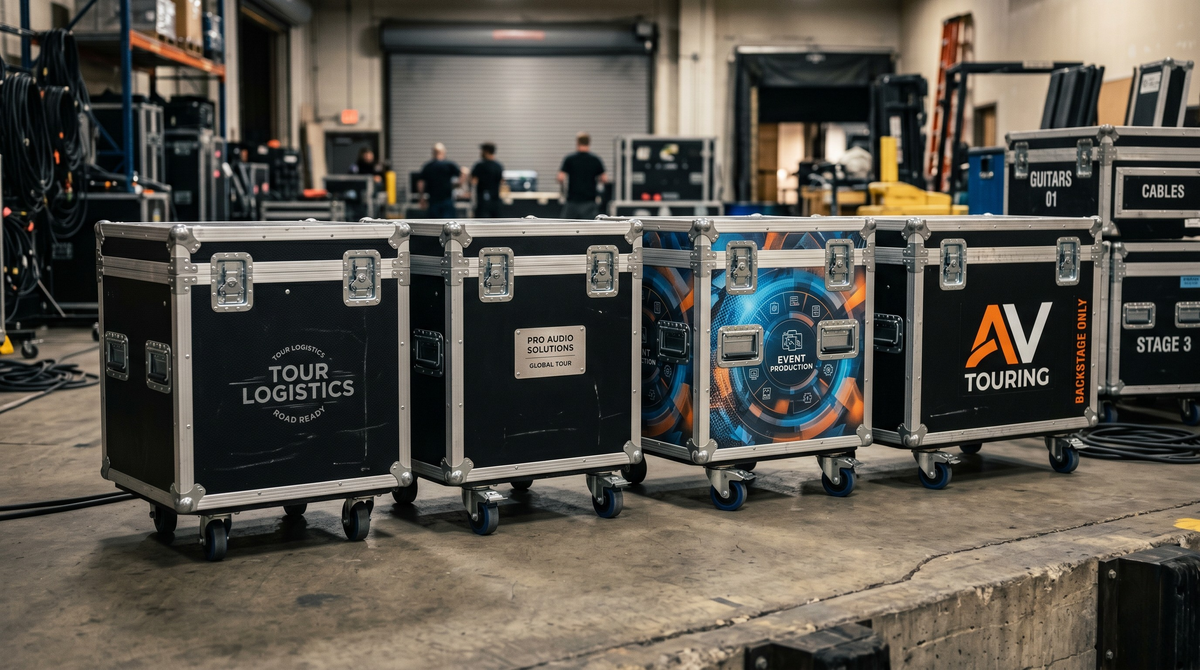
When people say custom branded ATA cases, they usually mean one of three things: a logo applied on top of the existing skin, a mark cut into metal, or the skin itself changed to a brand color or printed graphic. You can also combine them. A touring vendor might run a brand-color laminate skin with a screen-printed logo on the lid, plus an engraved asset tag on a nameplate. Knowing what each method does to the surface is the whole decision.
Logo and screen printing
Screen printing lays ink directly onto the case laminate. It is the most common way to brand a road case because it is fast, repeatable, and cheap per unit once the screen is made. A clean one-color or two-color logo on a black or colored skin reads from across a room and costs very little to add across a run of cases.
The tradeoffs are real. Screen printing wants simple, high-contrast artwork: solid shapes, bold type, a tight color count. Fine gradients and photographic detail do not hold up the way they would on a printed wrap. The ink sits on the surface, so years of stacking, strapping, and dragging through truck doors can scuff or wear a printed logo, especially on edges and high-contact panels. For most shops that is an acceptable trade, since a printed logo is also the cheapest to refresh on the next batch.
Print works on almost any case style with a flat panel, from a rack lid to the broad sides of ATA utility trunks that travel as a set. If your goal is to mark a fleet so it reads as yours at a glance, and your logo is a clean vector, printing is usually the right first answer.
Engraving and metal nameplates
Engraving cuts the mark into the material instead of laying it on top. On a road case that usually means a laser-etched or mechanically engraved aluminum nameplate riveted to a panel, or a mark cut directly into a metal surface or hardware. Because it removes material, an engraved mark does not scuff off. It survives the kind of abuse that wears printed ink, which is why asset tags, serial numbers, and company name plates are so often engraved.
The look is understated and premium. Engraving reads as a single tone, so it is not the method for a full-color brand identity. It shines for small, permanent details: a logo lockup on a nameplate, a department or rig number, contact info for return shipping, or an inventory code that has to stay legible for the life of the case. Many fleets pair an engraved asset plate with a printed or laminate brand mark so they get both permanence and color.
Engraving fits cases that get tracked tightly, like rack-mount ATA cases in a rental inventory where every unit needs a permanent ID that will not rub away between gigs.
Laminate color and full-wrap graphics
Laminate branding changes the skin of the case itself rather than adding a logo to it. There are two flavors. The first is a brand-color laminate: instead of standard black, the case is built with a colored ABS or PVC laminate that matches your identity. The color is the surface, so it cannot scuff off the way printed ink can, and the whole case reads as yours from any angle.
The second is a printed or digital laminate wrap, where full-color artwork is printed across the panels. This is the method that handles photographic detail, gradients, and edge-to-edge graphics. It is the highest-impact option and the natural choice when the case is part of the show, like a staging crate at a retail activation or the hardware behind an exhibit. For branding that has to look finished on camera, a wrapped case beats a printed logo on a plain skin every time.
Laminate runs cost more than a simple screen print, and custom artwork takes setup. The payoff is coverage and durability together: a colored or wrapped skin is the surface, not a coating on it. Exhibit builders and event teams often spec it on trade show display cases where the case is seen as much as the gear inside it.
Side-by-side comparison
Each method wins on a different axis. Use this as a quick reference, then match it to how your cases actually get used.
| Method | Best for | Durability | Color range | Relative cost |
|---|---|---|---|---|
| Logo / screen printing | Simple logos across a fleet | Good, can scuff over years | 1 to 4 solid colors | Lowest |
| Engraving | Asset tags, permanent IDs | Permanent, cut into material | Single tone | Low to medium |
| Brand-color laminate | Whole-case brand color | Excellent, color is the surface | Solid custom colors | Medium |
| Printed laminate wrap | Full-color, on-camera graphics | Excellent, integrated skin | Full color, photographic | Highest |
Compare your options
Running branded cases as your own product line, or kitting out a fleet under your name? The private label program lets you set the skin, logo, and hardware as a repeatable spec.
Explore private label manufacturingWhich method fits your use case

The method follows the job. Here is how the three break down by who is buying and why.
Touring and live production
Cases live on trucks and get dragged across loading docks for years. A screen-printed company logo plus an engraved asset plate is the workhorse combo: cheap to mark the whole rig, permanent on the ID that matters for return shipping. Save the printed wrap for the few cases that face the audience.
AV rental and integration
Rental inventory needs permanent IDs above all, so engraving earns its place on every unit. A brand-color laminate makes the fleet instantly recognizable on site and signals that the gear is professionally maintained, which matters when clients see it.
Exhibitors and retail activations
When the case is part of the display, go full wrap. Printed laminate carries your full-color identity across the panels and reads cleanly on camera and in photos. This is the one case where the highest-cost method is clearly worth it.
Industrial and field service
Durability and traceability lead here. Engraved asset and safety info plus a printed logo gets the job done without paying for graphics that the field would only scuff up.
Durability, reorders, and cost at volume
Two factors decide the real cost of branded cases over time: how the mark holds up, and how easily you can reorder a matching batch. Screen printing is cheapest up front and easy to repeat, but a printed logo on a high-contact panel may show wear before the case retires. Engraving never wears, though it is limited to small monochrome marks. Laminate skins, colored or wrapped, are the most durable because the branding is built into the surface rather than applied over it, and they carry the highest setup cost.
Volume changes the math. Setup costs like screens and print files spread across more units, so per-case branding gets cheaper as the order grows. If you expect to reorder the same spec, lock the artwork, colors, and hardware once so every future batch matches. For larger runs, ask about bulk pricing on ATA cases before you finalize, since the branding method and the order size both move the number. The cases are built to order in the first place, which is what makes consistent custom branding possible across a run. You can read more about how that works on the Gravix manufacturing background.
How Gravix builds branded and private-label cases
Because Gravix builds ATA cases to spec rather than pulling them off a shelf, branding is part of the build, not an afterthought stuck on later. That means the logo, the skin color, the hardware, and the interior can all be specified together, so a branded case still meets ATA-300 construction standards with the same plywood panels, aluminum extrusion, ball corners, and recessed hardware as an unbranded one. Branding does not compromise protection.
For one-off branded cases or a custom size, the path is a quote. For an ongoing branded line, where you want the same case produced under your name on a repeatable spec, private label is the structure that fits. Either way, the surface choice you make here, printing, engraving, or laminate, becomes part of the documented spec so future orders come out identical. Tell us the artwork, the colors, the case type, and the quantity, and we will recommend the branding method that matches your budget and how hard the cases will work.
Get a quote on custom branded ATA cases
Send your logo, case type, branding method, and quantity, and we will spec a build to order with pricing that matches your run.
Request a Custom Quote →FAQ
What is the most durable way to brand an ATA road case?
Laminate branding is the most durable because the brand color or printed graphic is the case skin itself, not a coating applied on top, so it cannot scuff off. Engraving is equally permanent for small monochrome marks since it cuts into metal. Screen printing is durable enough for most uses but can wear on high-contact panels over years of touring.
Can I put a full-color logo on a road case?
Yes. For full-color or photographic artwork, a printed laminate wrap is the right method, since it reproduces gradients and detail across the panels. Screen printing handles roughly one to four solid colors and works best for clean vector logos. Engraving is single-tone and suited to small marks, not full-color branding.
How many custom branded cases do I have to order?
Because the cases are built to order, you can brand a single case or a full fleet. Branding setup costs like print screens spread across more units, so the per-case cost drops as the order grows. For larger runs, ask about bulk pricing and private label so the spec stays identical across every reorder.
Does branding affect how well the case protects my gear?
No. Branding is applied to the same ATA-300 build, with plywood panels, aluminum edge extrusion, ball corners, and recessed hardware. A printed logo, an engraved plate, or a custom laminate skin changes the look, not the structure, so a branded case protects gear exactly like an unbranded one.
What is the difference between printing and laminate branding?
Printing applies ink on top of the existing case skin, which is cheap and great for simple logos but can scuff over time. Laminate branding changes the skin itself, either a custom brand color or a full printed wrap, so it covers more surface and lasts longer. Printing suits fleet marking, laminate suits high-visibility, on-camera cases.
Can I combine branding methods on one case?
Yes, and many buyers do. A common combination is a brand-color laminate skin with a screen-printed logo on the lid and an engraved asset plate for a permanent ID. Combining methods lets you balance color, visibility, and traceability on the same case. Specify all of it together so future reorders match exactly.